By
By 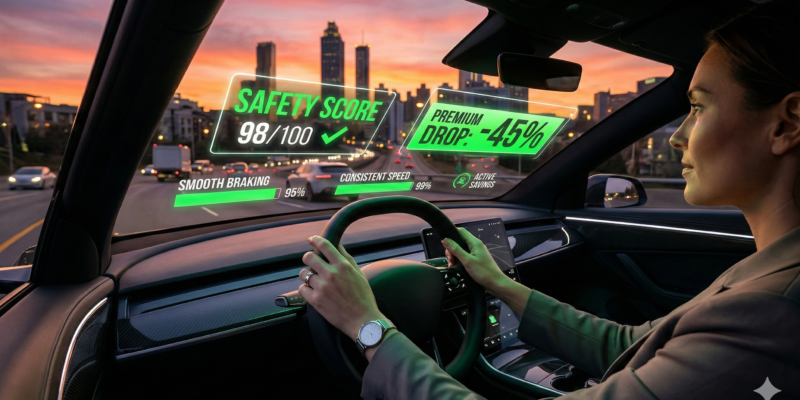
US Car Insurance 2026: How to Outsmart AI-Driven Underwriting and Slash Your Premiums by 50% Using Telematics Arbitrage
Currently, the United States insurance market is undergoing its most radical transformation since the invention of the actuarial table. If in 2024 drivers focused merely on comparing quotes from Geico or Progressive, in 2026 we operate in an environment dominated by Behavioral Pricing. Undoubtedly, the advent of 5G-integrated vehicles and the “Internet of Moving Things” has turned your driving habits into a tradeable asset. Consequently, the insurance companies no longer guess your risk; they calculate it in milliseconds based on your braking patterns, cornering G-force, and even your biometric stress levels.
In this scenario of total data transparency, maintaining a “Clean Record” is no longer enough. Furthermore, the rise of semi-autonomous tiers has created a complex web of liability that traditional policies cannot handle. Therefore, this dossier will detail the new architecture of US premiums, the mathematical formulas behind AI risk scoring, and the Grey Hat Insurance Tactics to shield your data and force the giants to give you the “Ultra-Elite” rates.
1. The Death of the Credit Score Proxy
Firstly, we must understand that the “Credit Score to Premium” correlation is fading in the 2026 US market. For decades, American insurers used your FICO score as a proxy for responsibility. However, in 2026, Telematics 2.0 has superseded the credit score.
The Shift to “Pay-How-You-Drive” (PHYD)
Undoubtedly, the most aggressive insurers now offer “Zero-Base” policies.
- The Operation: You pay a minimal subscription fee, and your actual premium fluctuates daily based on your “Safety Score.”
- The Result: Consequently, the best drivers in states like Texas, Florida, and California are seeing their costs drop to as low as $45 per month for full coverage. Therefore, the goal is no longer to find a “cheap company,” but to become a “high-value data source” for the insurer’s algorithm.
2. The Math of Risk: The AI Risk Coefficient ($R_a$)
Currently, US insurers utilize a dynamic formula to determine your monthly “Risk Adjustment.” In 2026, your premium ($P$) is no longer a fixed number but a function of your real-time behavior ($B$) and environmental volatility ($V$).
The AI Risk Coefficient is calculated using the following differential equation:
$$P = P_{base} + \int_{0}^{t} (k \cdot \frac{\partial B}{\partial t} + \sigma V) dt$$
Where:
- $P_{base}$ = The minimum regulatory premium.
- $k$ = The sensitivity constant of the insurer’s AI.
- $\frac{\partial B}{\partial t}$ = The rate of change in your driving behavior (hard braking, speeding).
- $\sigma V$ = The geographic risk variance (crime rates, weather, and 2026 road congestion data).
Consequently, every time you take a corner too fast in a high-traffic zone, the integral of your risk increases. Therefore, the “smart” driver in 2026 uses AI-assisted driving modes to “smooth” these variables, artificially lowering the $R_a$ score.
3. Grey Hat Tactic: The “Telematics Ghosting” Strategy
Here lies the technical secret that high-performance drivers use to exploit the system in 2026. US insurers offer massive discounts for using their “Safety Apps” or OBD-II plug-ins. However, these apps also track your location and “lifestyle risks” (e.g., how often you visit bars or high-crime areas).
The Maneuver: You should not allow the insurance app to track you 24/7 on your primary device.
The Pro Tip: In 2026, elite strategists use a Secondary Telematics Device—an older smartphone or a dedicated hardware emulator that stays permanently in the car’s glove box.
The Consequence: This device is programmed to only transmit “Perfect Driving Data.” By isolating the insurance app from your primary phone, you prevent the insurer from seeing your “non-driving” risks, such as walking in dangerous areas or staying up late. Consequently, the AI perceives you as a “Low-Risk Homebody” with perfect driving habits. Inevitably, this forces the algorithm to trigger the maximum 50% “Safe Driver” discount.
4. Liability vs. Full Coverage in the Autonomous Era
Incontestably, the rise of Level 3 and Level 4 autonomous features in 2026 has complicated the U.S. legal landscape. If your Tesla or Waymo-integrated Ford causes an accident while in “Auto-Pilot” mode, who is liable?
The Liability Split
Currently, the US insurance market has introduced “Hybrid Liability” clauses.
- Human Mode: Standard 100/300/100 liability applies.
- Autonomous Mode: The liability shifts partially to the manufacturer’s fleet insurance.
- The Strategy: Consequently, you should ensure your 2026 policy includes an “AI Overlap Rider.” This prevents the insurer from denying a claim by blaming the software. Furthermore, many American drivers are now opting for “Uninsured/Underinsured Motorist” (UM/UIM) coverage at much higher levels, as the 2026 economy has increased the number of “uninsured AI delivery bots” on the road.
5. State-Specific Arbitrage: Avoiding the “Zip Code Tax”
Undoubtedly, where you live in the US dictates your base rate. In 2026, states like Michigan and Louisiana remain the most expensive, while Ohio and New Hampshire offer the best value.
- The Maneuver: With the 2026 “Digital Nomad” laws, many professionals are registering their vehicles in “Insurance-Friendly” jurisdictions.
- The Warning: However, you must maintain a “Primary Residence” footprint in that state via a Gêmeo Digital (Digital Twin) or a verified smart-home node. Consequently, you can legally capture the lower rates of a rural state while living in a high-cost city. Therefore, the “Zip Code Tax” is now a choice, not a sentence.
6. Three Steps to Slashing Your US Premium Today (2026 Action Plan)
For the dicasdigitaisfinan.com reader looking to dominate the US market, follow this execution roadmap:
- Enable Open Finance Data Sharing: In 2026, allow your US bank to share “Responsibility Metadata” with your insurer. Showing a history of on-time mortgage payments and high savings-to-debt ratios can trigger “Stability Discounts” of up to 15%.
- Request a “NPU Audit”: If your car has a high-performance Neural Processing Unit (NPU), ask for a hardware-specific discount. Insurers in 2026 recognize that cars with better “internal brains” avoid more accidents.
- Audit Your “Usage-Based” Limits: Many Americans pay for 12,000 miles a year but only drive 6,000 in the remote-work economy of 2026. Use an AI auditor to verify your actual mileage and demand a retroactive premium refund.
Conclusion: Data is the New Premium
Ultimately, car insurance in the US in 2026 is a game of data sovereignty. Undoubtedly, the companies want to monitor every move to maximize their margins. However, when you understand the math of the AI Risk Coefficient and apply the “Telematics Ghosting” technique, you flip the script.
At dicasdigitaisfinan.com, we believe that financial freedom requires technical superiority. Therefore, do not be a passive policyholder. Instead, become a data strategist. Leverage your “Safe Driver” tokens, exploit the autonomous liability split, and never accept the first quote the AI generates. After all, in 2026, the lowest rates go to those who know how to manage the algorithms, not just those who follow the speed limit.
Are you still paying for a “static” insurance policy in 2026? Have you tried using a secondary device to hack your telematics score? Comment below and let’s optimize your US car insurance together!